
Money will work for you every single day without complaint. The tricky part is telling it exactly where to go. Most founders never figure that out. The money is moving. It is just moving in the wrong direction. And it is one of the most common ecommerce cash flow problems I see.
That is what this audit is about.
I use public brands as case studies because the patterns are always the same whether you are doing $3M or $12M. All top line numbers are estimates taken from public data. Watch the full video audit on YouTube:
What She Built
Olamide Olowe pitched investors for two years before anyone said yes.
Two years. Of nos. Of closed doors. Of people not seeing what she saw.
Then 2020 arrived. COVID. Black Lives Matter. The Sephora 15 Percent Pledge. And she was ready. Her brand built for people with chronic skin conditions like hyperpigmentation and eczema launched directly into the wave. She didn't get lucky. She was prepared. There is a difference and I need you to feel that difference.
By 2026 she had raised $22.6 million total. Her products were in hundreds of Sephora doors. Her eye patches were estimated to be moving over 20,000 units a month on Amazon at a 4.5 star rating. She had built a rewards program, an ambassador network, an esthetician program, and a subscription offering.
Brand trips to Bermuda. Ghana. Morocco. Lagos. Brazil. Thailand.
She built the infrastructure. She built the community. She built the distribution.
And girl the money is sitting right there and nobody told her.
The Calculator Finds What Your P&L; Is Hiding
I never start with the spreadsheet. I start with the vision.
Because here is the thing. You cannot read the numbers if you don't know where you are trying to go. The numbers only make sense in the context of the dream.
For Topicals the vision is clear: investor backed, building toward an exit. She raised $22.6M. She is in year six. The clock is ticking. And the standard expectation for a VC backed brand at this funding level is $25M to $40M in revenue by now.
Estimated revenue? Around $12M.
That gap matters. A lot. And it is not a tragedy. It is a signal. Signals are exciting to me because signals mean there is something to find.
So I ran the numbers. Top line revenue. Inventory cash flow. Marketing spend. Fixed costs. Four buckets. That is all you need to see where the cash is getting stuck. Want to run your own numbers? Use the free cash flow calculator at tricepruitt.com and find your trapped cash in under two minutes.
For Topicals I am estimating roughly $150,000 a month in trapped cash.
Isn't that wild? $150,000. Every single month. Just sitting there.
And almost all of it is in one place.
The Channel Mix Problem
Here is the part that makes me want to grab every founder by the shoulders.
Topicals sells the same $38 serum in three places: their Shopify store, Sephora, and Amazon. Same product. Same customer. Three completely different outcomes.
On Sephora, after wholesale pricing and manufacturing costs, Topicals walks away with roughly $10 in gross profit per unit.
Amazon tells the same story. After fees and COGS, the ecommerce gross margin lands in that same compressed range.
On their own Shopify store? That number climbs to around $25.
Nearly three times the gross profit. On the exact same product. With the exact same customer.
No new ads. No new SKUs. No new anything. Just a different checkout page.
And right now an estimated 75% to 80% of their revenue is flowing through Sephora and Amazon.
That is the leak. That is where the $150,000 a month is getting stuck. And once you see it you cannot unsee it. It is not a money problem. It is a channel problem. The money is flowing in the wrong direction.
As a fractional CFO for Shopify brands I see this same DTC cash flow problem in almost every audit I run.
The brand is not broken. The direction the money is flowing is broken.
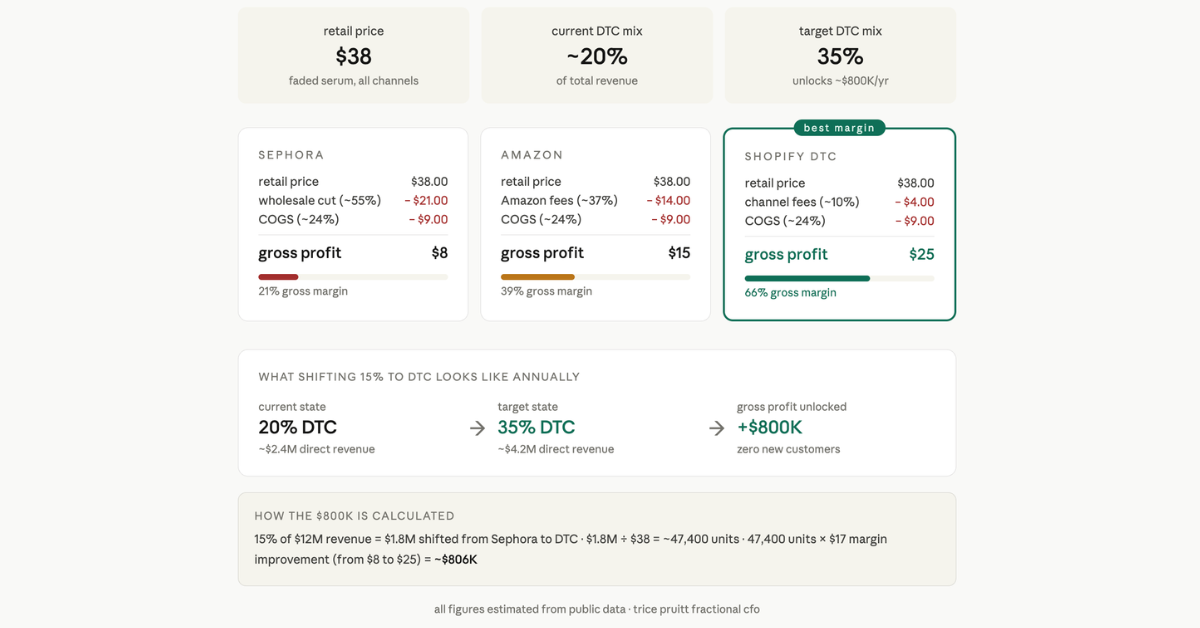
Same $38 product. Three channels. Three completely different gross profit outcomes. (All figures estimated from public data.)
The Fix That's Already Been Proven
I love this part. This is my favorite part. Because the fix is not new. Not complicated. Not expensive.
Estee Lauder pioneered this mechanic and built a $14 billion company on the back of it.
Free with purchase.
A branded pink pouch. Mini Faded Serum. A three pack of eye patches. Mini Slick Salve. Available exclusively when you buy directly from mytopicals.com with a $75+ order. Cost to Topicals: maybe $10. Perceived value to the customer: $40+.
Isn't that so cool? The customer feels like they won. And Topicals wins twice.
Here is why it works mathematically.
Every customer buying that same serum through Sephora is worth $10 in gross profit to Topicals. That same customer buying direct is worth $25. That is a $15 difference per order before they ever buy again.
The free gift converts the channel. The channel converts the margin. And every single repeat purchase compounds that $15 gap forward indefinitely. That is money magic right there.
No new products. No new staff. Live on Shopify in days.
If Topicals shifts their DTC mix from 20% to just 35% over the course of a year, one focused campaign not a transformation, the math shows over $700,000 in additional gross profit annually.
Not from new customers. From the ones they already have. Buying from a different page.
Lady luck is not even involved. This is just math.
But Cash Alone Won't Get Them to the Exit
Here is where I have to be real with you.
Topicals needs cash. But what they actually need is a company worth buying.
They have raised $22.6M into a business estimated at $12M in revenue with four years left on a typical VC clock. At a standard 2x multiple that is a $24M exit on $22M invested.
That math does not work for anyone at the table.
So the cash fix is real. And it is urgent. But it is not the whole story.
The 10X Move Nobody Has Named Yet
Every major growth moment in Topicals history came from catching an external wave.
The 2020 racial justice movement. The COVID DTC boom. The Sephora 15 Percent Pledge. The Angel Reese partnership. They caught every single one beautifully. The execution was gorgeous.
But here is the problem with riding waves. They end.
In January 2026 Olamide said something that stopped me cold. Investors are pulling back their belief in Black owned businesses. The last round was funded by celebrities not institutional VCs.
The wave ran out.
So what do you do when the wave runs out? You stop waiting for the ocean to do the work. You become the wave.
Let me tell you about L'Oreal.
The 1970s. Every beauty ad in America was some version of: look beautiful for your man. A copywriter named Ilon Specht got fed up. She wrote:
"I use the most expensive hair dye. Because I'm worth it."
That line named a feeling that was already everywhere in the public consciousness. It took an invisible undercurrent and made it visible. It made it loud. It made it a movement.
And it built one of the most valuable beauty companies in the world.
Isn't that so cool? Four words. One of the biggest beauty empires ever built. That is money magic on a cultural
scale.
The Category That Nobody Has Claimed
Here is what excites me most about this audit. And I mean genuinely excites me.
There are over four billion people on this planet with Fitzpatrick 6 to 3 skin tones. Black, Hispanic, South Asian, Middle Eastern, Southeast Asian, mixed race women. The majority of humanity.
And there is not a single major skincare brand built exclusively for them.
Not one.
Nobody has stood up and said: this brand exists for Fitzpatrick 6 to 3.
The big conglomerates cannot do it. L'Oreal cannot do it. Estee Lauder cannot do it. Not credibly. They do not have the cultural roots. It will feel forced. It will feel like exactly what it is: a corporation trying to buy trust it never earned.
But a Nigerian American founder who built her company for people with chronic skin conditions? Who already has the trust of Black and brown women across the globe? Who has been doing brand trips in Lagos and Brazil and Thailand?
She could name that wave.
Black and brown women are the fastest growing entrepreneurs in America. Their collective buying power is nearly $2 trillion. Their wealth grew 61% between 2019 and 2022. That energy is already in the air. It is already there. It just needs someone to name it.
That is Topicals' move. And oh my God is it a good one.
Not a rebrand. Not a pivot. A language shift. A category claim. The same move Spanx made when Sara Blakely named shapewear and sold the company for $1.2 billion. The same move Warby Parker made when they named accessible premium eyewear and IPO'd at $6 billion.
The founder who names the gap people are already begging for can build a billion dollar company. Olamide is standing at that exact door.
What the Numbers Look Like If They Make the Move
A $12M brand with compressed margins and no category claim? At a 2x multiple that is a $24M exit on $22.6M invested. Nobody is celebrating that wire transfer.
But a brand that owns the skincare category for four billion people with cultural credibility no conglomerate can manufacture or buy? That is a completely different conversation.
That is an 8x multiple conversation. That is a $100M acquisition conversation. That is the permission slip that L'Oreal and Unilever and Estee Lauder will pay a serious premium to own.
The infrastructure is already there. The community is already there. The product is already there.
The move is simply naming what she has already created. And then letting the money do its job.
What This Means for Your Business
You do not need $22 million in VC funding for any of this to apply to you.
If you are doing $2M to $15M in revenue and it feels harder than it should, if you are moving product through channels that are quietly eating your margins while your Shopify cash flow sits underutilized, the cash is already in your business.
It is just waiting for someone to tell it where to go.
This is exactly what I do as a fractional CFO for Shopify brands. I find where the cash is trapped, free it up, and use it to scale toward the vision you are actually building toward.
The audit I ran on Topicals takes four numbers. Top line revenue. Inventory costs. Marketing spend. Fixed costs. That is it. Run your own numbers at tricepruitt.com and see where your cash is getting stuck.
Ready to Find Your Move?
Girl, the money is sitting right there. Let's go find it.
Most founders have no idea what their Shopify brand valuation actually is until someone runs the numbers. That number changes everything. It changes how you price your time, how you talk to investors, and how you make decisions about where to put your energy.
As a fractional CFO for Shopify brands I work with ecommerce founders doing $2M to $15M who are tired of revenue that does not feel like freedom. My job is to find where the cash is trapped, free it up, and use it to scale toward the exit or the next level you are actually building toward.
I charge $5K a month. I find you $50K to $200K in freed cash within 90 days. Or you don't pay again.
That is not a marketing line. The guarantee is real because the cash is always there. It just needs someone to find it.
Book your free Show Me the Money Audit at: tricepruitt.com/show-me-the-money-audit
Frequently Asked Questions
What does a fractional CFO actually do for a Shopify brand?
Not just bookkeeping. A fractional CFO looks at your full financial architecture — channel mix, inventory strategy, marketing spend, pricing, cost structure. The job is to find where cash is trapped and show you the move that frees it. For most Shopify brands doing $2M to $15M, that is $50,000 to $200,000 already sitting in the business. Just not visible yet.
How do you find cash flow problems in an ecommerce business?
I start with the vision, not the spreadsheet. Then I look at the whole system — brand positioning, channel mix, margins, inventory, the way money is actually moving. The Topicals audit is a perfect example. The cash was not missing. It was flowing through the wrong channels. Once you see that, the fix becomes obvious.
What is the difference between a cash flow problem and a profitability problem?
Profitability problem: your margins are too thin. You are not making enough on what you sell.
Cash flow problem: the money is there but it is stuck — in inventory, in overhead, in slow turning channels.
Most founders think they have a profitability problem. Most of the time it is actually a cash flow problem. Topicals is a perfect example. Strong margins. $150,000 a month flowing in the wrong direction.
Is it worth hiring a fractional CFO at $3M to $5M in revenue?
Yes. And the best time is before the crisis — not during it. At $3M to $5M the patterns that will either scale your business or cap it are already forming. A fractional CFO finds the leaks early, builds the financial architecture for the next level, and typically returns far more than the retainer within 90 days.

About the author
Trice Pruitt is a Fractional CFO for Ecommerce businesses. With almost two decades and 8,160+ hours of one-on-one advisory, she helps founders fix cash flow, scale their brands, and build toward exit. This is where the money magic starts.