
You had a great sales month. The numbers look good. Your ads manager is thrilled. You're moving inventory.
So why does your bank account look like you barely survived?
This is the question that drives Shopify founders absolutely crazy. And honestly? It drives me a little crazy too — not because it's unsolvable, but because it's so preventable once you understand what's actually happening.
Let me show you exactly where the money goes. Or better yet — [watch me break it down live in this video.]
The Cash Flow Mystery Nobody Explains
Let's walk through a real example. Simple numbers, but this is exactly what I see playing out in real ecommerce brands every single day.
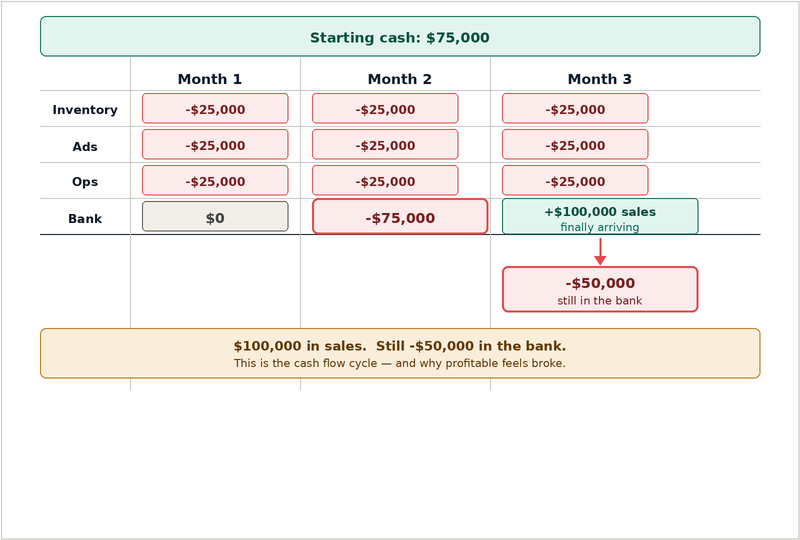
You start your business with $75,000 in cash. Clean slate. Month one, you're ready to build.
Here's what month one looks like for most Shopify founders in luxury accessories or DTC brands:
- $25,000 in inventory — custom-made items, manufactured overseas
- $25,000 in advertising — you've heard this a thousand times: never turn off the ads
- $25,000 in ops — your team, your tech stack, all the things that keep the lights on
End of month one: $0 in the bank.
Totally normal. Not fun, but normal.
Here's Where It Gets Painful
Here's the part most Shopify founders don't see coming.
Those custom items you ordered in month one? They're not ready to sell until month three. That's just how luxury accessories work — overseas manufacturing, lead times, shipping. The product is tied up in transit while your ecommerce business keeps moving.
So in month two, you still have to buy more inventory to keep the pipeline flowing. You still have to run ads. You still have to pay your team.
Month two: another $75,000 out the door.
Running total out of pocket: $150,000. Cash in bank: -$75,000.
Month Three — The Light at the End of the Tunnel
Finally, month three arrives. The inventory lands. You start making sales.
Let's say everything goes beautifully. You have amazing profit margins. The ads are converting. You sell $100,000 worth of product.
Surely the bank account looks better now, right?
Here's the catch.
You still have that $75,000 from month two working its way through the pipeline — inventory you paid for that hasn't sold yet. That money is trapped in the system. Plus you spent another $75,000 in month three on costs.
So your bank account shows -$50,000.
Not $100,000. Not the profit your P&L is showing. Negative fifty thousand — because the rest is sitting in inventory, in transit, in the gap between when you paid and when you got paid back.
This Is What "Profitable but Broke" Actually Means
Your profit and loss statement looks great. Technically, you are profitable.
But your bank account tells a completely different story — and that gap is what I call the cash flow cycle. It's the time between when cash leaves your ecommerce business and when it comes back. For Shopify founders in accessories, apparel, and luxury goods, that cycle can stretch weeks or even months.
This isn't a sign that your business is failing. It's a sign that your business is growing — and that growth requires working capital you may not have accounted for.
The faster you scale your Shopify store, the worse this feels. More growth means more inventory, more ads, more overhead — all going out the door before the revenue comes back in.
Why This Matters More as You Scale
Most founders I work with as a fractional CFO for Shopify brands hit this wall somewhere between $2M and $5M in revenue. The business is genuinely doing well. Customers love the product. The brand is building. But every time they try to scale, cash gets tighter instead of looser.
That's the cash flow cycle compressing under growth pressure.
The bigger you grow on Shopify, the more working capital you need — and if you don't have a plan for managing that cycle, scaling actually makes the cash problem worse before it gets better.
This is exactly why having a fractional CFO in your corner — someone who understands both ecommerce cash flow and your specific DTC business model — changes everything. Not because the math is complicated. Because nobody showed you this picture before.
The Good News
There are real ways to shorten this cycle and get the cash moving faster. Ways to reduce the time money is trapped in your system without slowing down your growth or turning off your ads.
Start here — the Cash Leak Calculator is a free tool I built specifically for Shopify founders to show you where cash is getting stuck in your business and what to do about it.
It takes about five minutes and it will show you exactly what's happening between your profit and your bank account.
Once you know where your cash leak is, the next step is the Show Me The Money Audit — where we dig into your specific numbers together, identify what's trapping your cash, and map out the exact steps to free it.
Because understanding this is step one. And once you see it, you can't unsee it.

About the author
Trice Pruitt is a fractional CFO for ecommerce business. With almost two decades and 8,160+ hours of one-on-one advisory, she helps founders fix cash flow, scale their brands, and build toward exit. This is where the money magic starts.